
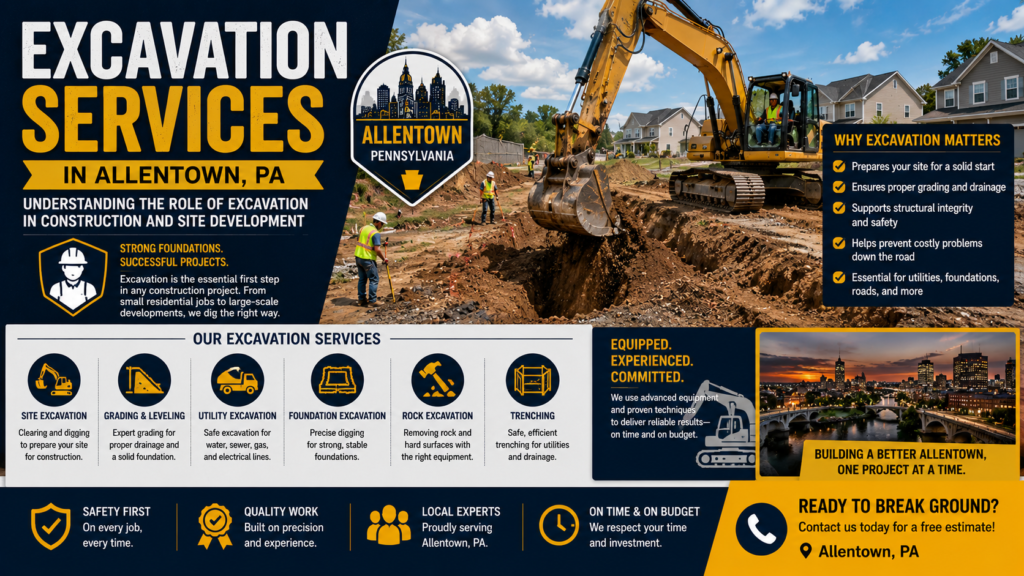
Excavation is one of the most fundamental services in the construction and site development industry, yet it is often misunderstood as simply moving dirt. In reality, excavation encompasses a wide range of precision operations that lay the literal foundation for everything from driveways and foundations to drainage systems and utility lines. In Allentown, Pennsylvania a city with a diverse mix of older residential properties, expanding commercial zones, and active industrial sites Excavation Service Allentown are in consistent demand and require skilled contractors who understand the local terrain and regulatory environment.
What Is Excavation and What Does It Involve?
Excavation is the process of removing earth, soil, rock, or other material from a site in preparation for construction or site improvement. While heavy machinery like backhoes, excavators, and bulldozers are the primary tools of the trade, the work is far more nuanced than operating equipment. Excavation contractors must:
- Assess the site and soil conditions before beginning work.
- Coordinate with utility companies to identify and protect underground infrastructure.
- Plan the sequence of operations to manage soil stability and drainage.
- Dispose of or reuse excavated material appropriately.
- Complete the work to specified grades and tolerances required by engineers or architects.
In Allentown and across the Lehigh Valley, soil conditions vary significantly from the rocky substrata of hillside properties to the clay-heavy soils of valley floors. An experienced excavation contractor will assess these conditions as part of project planning.
Common Applications of Excavation Services in Allentown
Excavation is required across a wide spectrum of project types in the Allentown area:
- Foundation excavation: Digging to the required depth for residential basements, commercial building foundations, and concrete slabs.
- Utility trenching: Creating trenches for water lines, sewer laterals, gas lines, electrical conduit, and telecommunications infrastructure.
- Driveway and parking lot sub-base preparation: Removing existing material and establishing the correct base depth for paved surfaces.
- Pool excavation: Excavating to the precise dimensions required for inground pool installation.
- Retaining wall construction: Excavating and preparing the base for retaining walls that manage grade changes on hillside or sloped properties.
- Land clearing and rough grading: Initial site preparation for new construction, including leveling and rough shaping of the terrain.
Utility Marking and Safety Before Any Excavation
One of the most critical preparatory steps before any excavation in Pennsylvania is contacting PA One Call (811), the state’s underground utility notification system. This service coordinates with utility companies to mark the location of buried infrastructure before digging begins. Striking an underground utility line can cause serious injuries, service outages, and significant liability.
Professional excavation contractors in Allentown make utility notification a non-negotiable first step on every project. Once utilities are marked, operators exercise heightened care within designated buffer zones around buried infrastructure, often hand-digging in sensitive areas where mechanical equipment could cause damage.
Excavation in Allentown’s Urban Environment
Urban excavation particularly in older established neighborhoods like those common throughout Allentown introduces unique challenges. Infrastructure is often dense, properties are close together, and underground utilities may not be documented accurately on older maps. Tree roots can extend well beyond the visible canopy and intersect with planned excavation paths. Existing structures may have foundations that require protection during adjacent work.
Contractors working in Allentown’s residential and commercial core must navigate these constraints with smaller equipment where necessary, careful shoring of open excavations, and constant communication with property owners about what to expect at each stage.
Drainage and Grading as Part of Excavation
Effective drainage is a central concern in any excavation project in the Lehigh Valley. Allentown experiences significant rainfall, and improperly graded sites can create drainage problems that damage foundations, flood basements, or erode newly constructed infrastructure.
Excavation contractors address drainage by establishing appropriate grades as part of the grading and filling operations that follow initial excavation. This involves shaping the terrain so that surface water flows away from structures toward storm drains, swales, or retention areas. In some projects, sub-surface drainage infrastructure perforated pipe, gravel blankets, or French drains is installed during the excavation phase to manage groundwater.
Excavation for Paving Projects
In the context of driveway and parking lot paving, excavation refers specifically to the removal of existing surface material and soil to the required sub-grade depth. For a typical residential driveway in Allentown, this might involve excavating to a depth of 8 to 10 inches, establishing the sub-grade, compacting it, and then installing the aggregate base before paving begins.
When existing pavement is present, this typically requires mechanically breaking up and removing the old surface. The resulting material may be recycled reclaimed asphalt pavement (RAP) has value in new paving mixes and as base fill or hauled off-site to a disposal facility.
Equipment Used in Excavation Operations
The range of equipment used in excavation work is broad, and matching the right equipment to the project scope is an important part of contractor planning:
- Mini excavators: Ideal for tight urban spaces, landscaping work, and utility trenching in residential settings.
- Full-size excavators: Used for deep foundation work, large utility trenches, and bulk earthmoving.
- Skid steer loaders: Versatile in tight spaces, useful for material handling and grading in confined areas.
- Bulldozers: Best suited for large-scale clearing and rough grading on open sites.
- Dump trucks: Required to haul excavated material off-site or move fill within the project area.
Conclusion
Excavation services in Allentown are the starting point for nearly every significant construction or site improvement project. Whether you are building a foundation, installing utilities, preparing for new pavement, or developing a property from scratch, the quality of the excavation work establishes the conditions on which everything else depends. Understanding what excavation involves and why it matters so much to the long-term success of any project helps property owners and developers make better decisions when selecting contractors and evaluating project plans.